- GitHub Repository — project materials, conference paper, analysis code, and figures
- Conference Paper — Integrating Artificial Intelligence into the Classroom: Evidence from a Conjoint Experiment, 25th IEEE International Conference on Advanced Learning Technologies (ICALT 2026)
- Journal Manuscript in Preparation
Project Overview
This project examines how students evaluate different forms of artificial intelligence (AI) integration in university courses.
Rather than asking whether AI should be used in higher education, the study asks:
How should AI be used in higher education?
Using a conjoint experiment, students evaluated hypothetical course policies that varied in:
- AI use in instructional materials
- AI use in assessments and grading
- AI-powered personalized support
The study measures perceived usefulness, support for adoption, and perceived autonomy.
Research Design
Conjoint Experiment
Participants evaluated randomly generated course policies composed of three dimensions:
| Attribute | Levels |
|---|---|
| Instructional Materials | No AI, AI reviewed by instructor, AI unreviewed |
| Assessments & Grading | Human grading, AI reviewed by instructor, AI unreviewed |
| Personalized Support | No chatbot, AI chatbot |
Each participant evaluated six randomly assigned profiles.
Sample
- Undergraduate students
- N = 358 respondents
- 2,148 profile evaluations
- Online Qualtrics survey
- Fall 2025
Main Finding
Students are not opposed to AI itself.
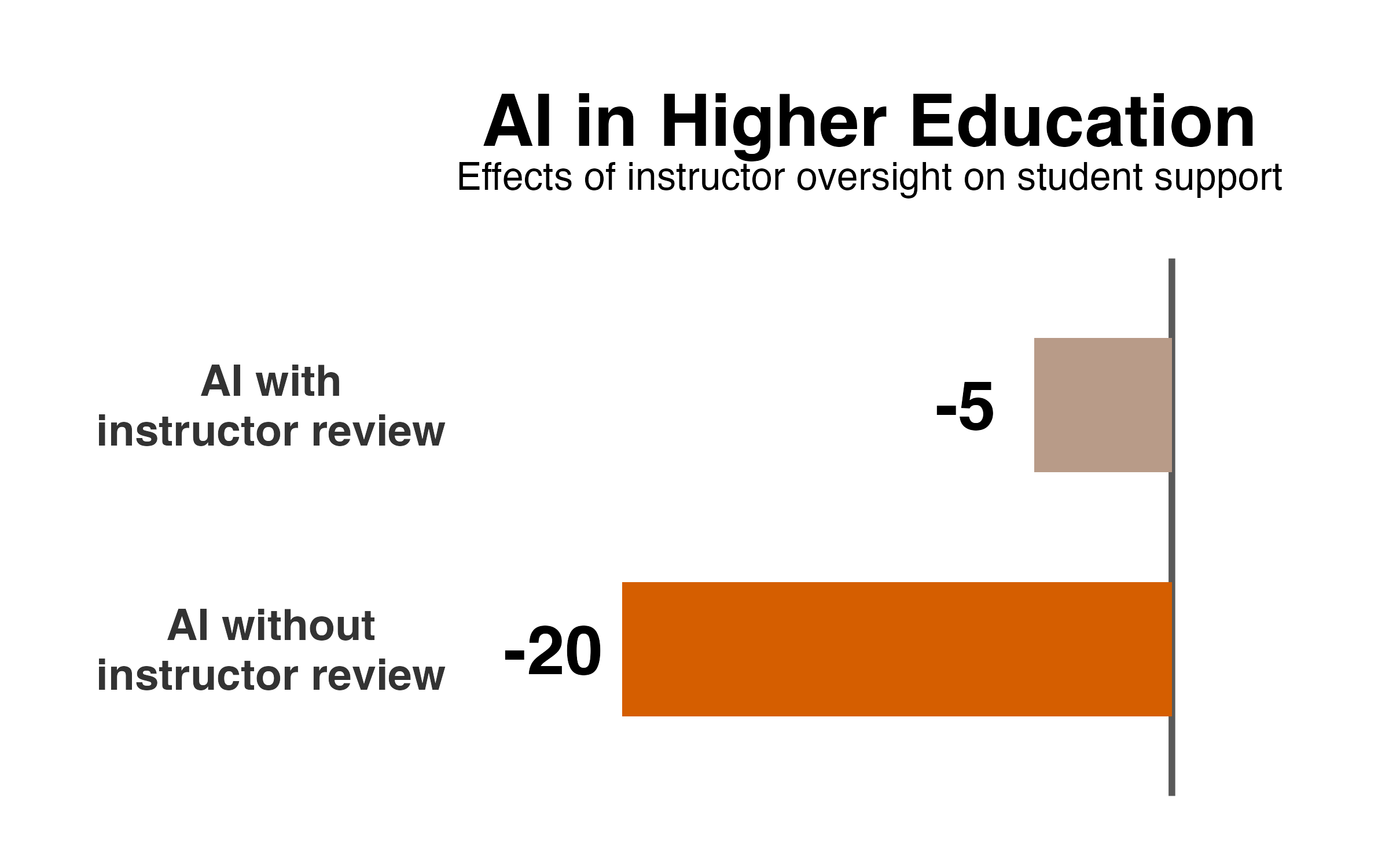
Students are opposed to AI operating without human oversight.
AI-assisted systems that remain under instructor review receive evaluations similar to traditional human-only approaches. By contrast, AI systems operating without instructor review produce substantial declines in support, perceived usefulness, and autonomy.
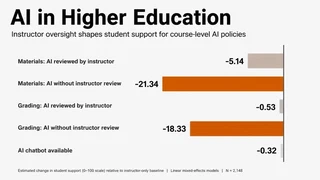
Evidence Across Student Evaluations
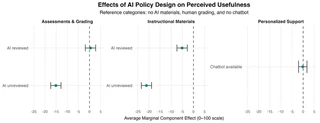
Perceived Usefulness
Students strongly penalize unreviewed AI systems, especially when used for grading and instructional materials.
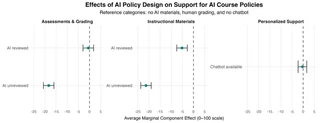
Support for Adoption
Support for AI adoption depends heavily on whether instructors remain involved in reviewing AI outputs.
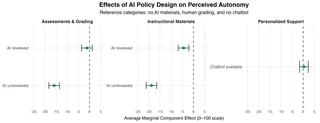
Perceived Autonomy
Students report lower autonomy when AI assumes responsibility for instructional or evaluative decisions without human oversight.
Additional Results
Consistency Across Outcomes
Coefficient estimates across perceived usefulness, support for adoption, and autonomy reveal a highly consistent pattern.
- AI without instructor review produces the largest negative effects.
- AI with instructor review produces substantially smaller effects.
- AI chatbot support has little effect on student evaluations.
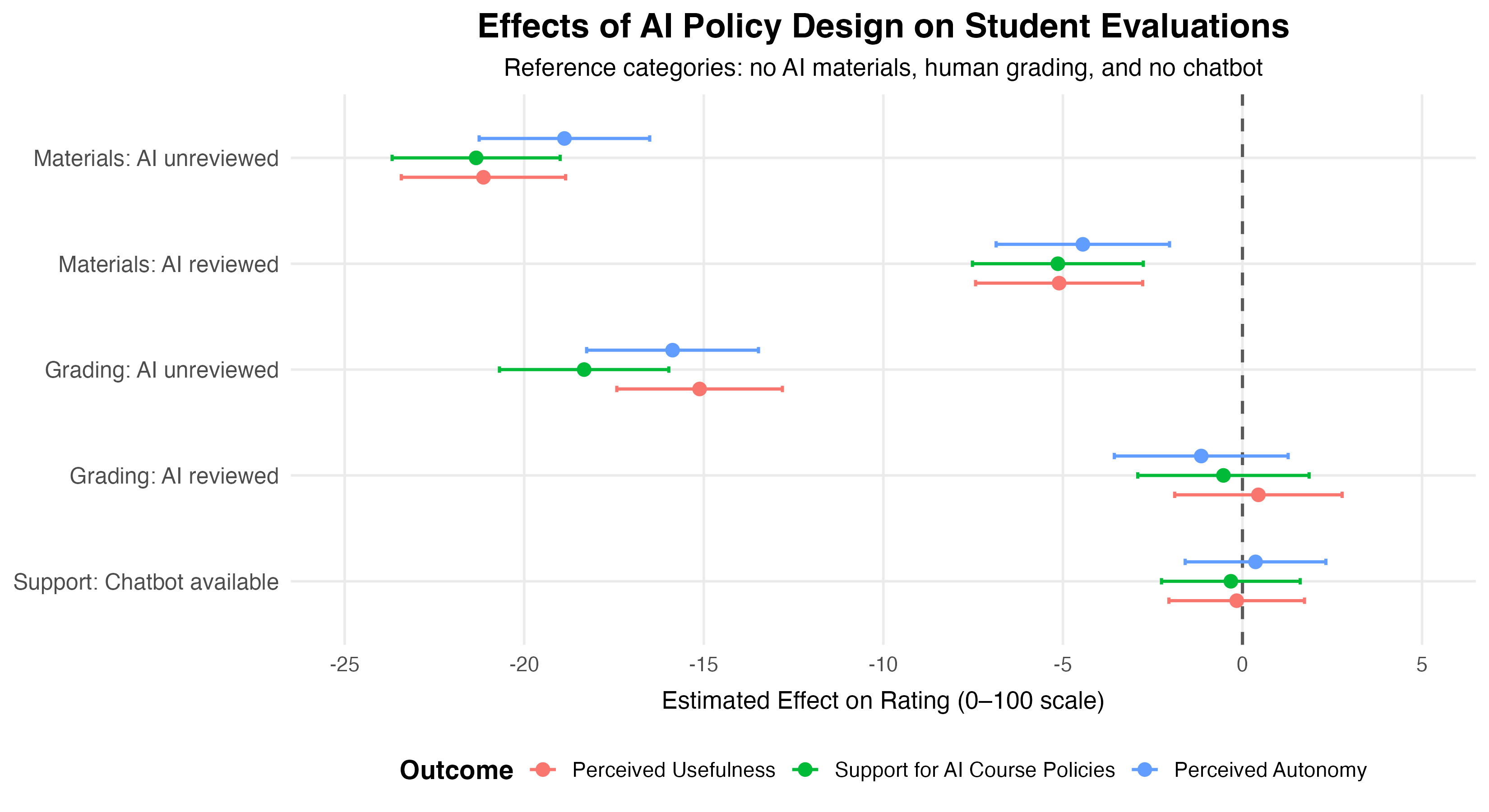
Comparison of estimated effects across perceived usefulness, support for adoption, and perceived autonomy. The pattern is highly consistent across outcomes, demonstrating that student acceptance of AI depends primarily on the presence of human oversight.
Research Contribution
This project contributes to research on artificial intelligence in higher education by providing causal evidence on how students evaluate alternative AI governance designs. The findings demonstrate that student acceptance of AI depends less on AI itself and more on how authority, accountability, and human oversight are structured within educational settings. The results have implications for universities, instructors, and policymakers seeking to integrate AI into teaching and learning while maintaining student trust and legitimacy.